
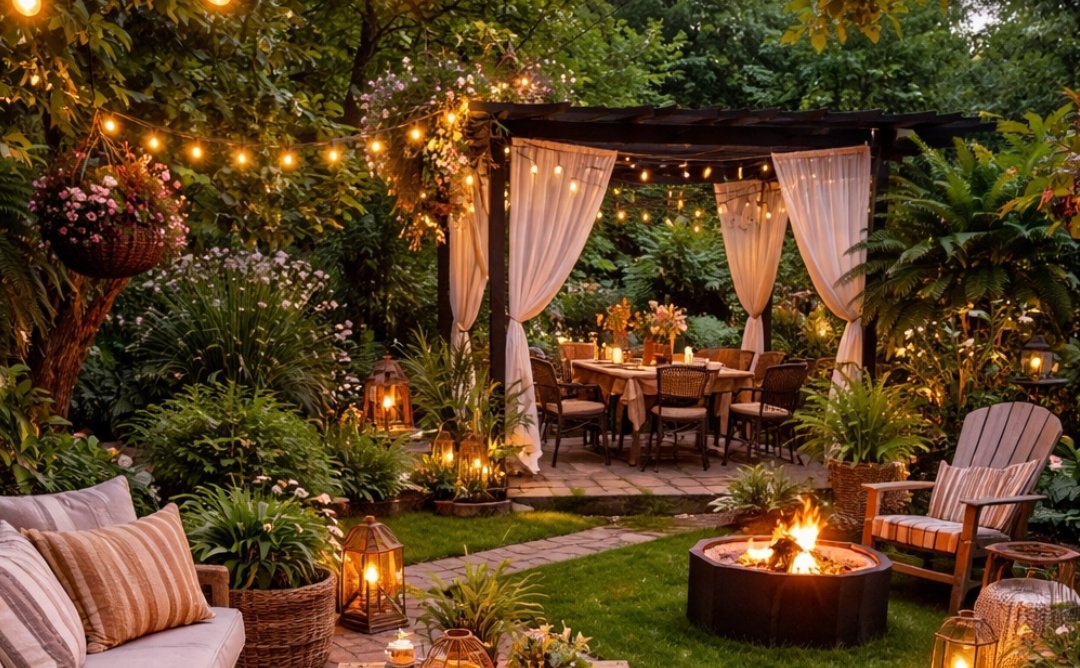

You have most likely entered a room – or a garden – and instantly felt something. A sense of calm. A spark of energy. A sense of everything being in place. Not a coincidence. That’s intentional design.
- Rules of Indoor Styling That Work.
- The 60-30-10 Color Rule
- Layering Your Lighting
- Furniture Scaling: The Rule That the Majority of people Disregard.
- Outdoor & Yard Mastery
- Zoning Your Yard in 10 minutes.
- Choosing Weather-Resistant Materials
- Hardscaping vs. Softscaping: Striking the balance.
- DIY Decor Hacks on a Budget.
- Decorating Dumb Things to Ruin Your Space.
- Seasonal Changes- Maintaining Your Tips Decoradyard Year Round.
- Until you get One Little Project.
Tips Decoradyard is more than a decorating style. It is a philosophy which poses one simple question in front of all design choices: Does this serve both beauty and purpose?
There are too many homeowners who commit one of the two traps. They either put so much emphasis on aesthetics as to render their homes unusable, gorgeous throw pillows that can’t be touched, a garden so well-tended that it can’t be played in, or they go to the other extreme and make their home cold and sterile through excessive functionality.
Tips Decoradyard approach is right in the middle. All your house upgrades, including a single houseplant, or your entire outdoor redesign, should pay off by serving a dual purpose: not only should it look good but also improve your life.
This guide will provide you with practical Tips Decoradyard on how to change not only your interior environment, but also your yard, no matter how much you have or how much you are a design expert. It’s time to begin constructing your dream space.
Rules of Indoor Styling That Work.
The 60-30-10 Color Rule
When you have ever stood in front of paint swatches and spent three hours of your life lost in confusion, this rule will transform your life.
You can simplify interior aesthetics dramatically when you split your palette of colors into three levels:
- 60% – Your Dominant Color: This is your walls, huge carpets, or a huge sofa. It sets the mood. The warm whites, greiges or soft sage are perfect neutrals here.
- 30% Your Secondary Color: This is used in bedding, accent chairs or curtains. It compliments and not competing.
- 10% — Your Accent Color: It is your riskiest option, whether it be throw pillows, artwork, vases, or a statement lamp. It generates visual vibrancy without clogging the room.
Imagine it like a custom-made clothes. Your suit is the 60, your shirt is the 30 and your pocket square is the 10. Every one has its purpose.
Layering Your Lighting
One of the most frequent reasons why a room can never quite feel right is single-source lighting. Functional living requires the use of lighting which varies in response to the needs during the day.
Construct each room three layers:
- Ambient lighting – your overhead lights or recesses. The foundation.
- Task lighting – Desk lamps, under-cabinet kitchen lights, bedside reading lights. These are used to serve certain activities.
- Accent lighting- Wall sconces, LED strips behind shelves or a spotlight on a work of art. These are bringing drama and dimension.
The goal is to never be dependent on just one switch. The same room is changed into a working environment during the day, and into a cozy and cozy getaway at night with their use of layered lighting.
Furniture Scaling: The Rule That the Majority of people Disregard.
The most common design mistake in the design world is oversized furniture in a small room and undersized furniture in a large room is a close second.
Measuring your space before buying any large item, draw a sketch of a floor plan. An excellent guideline: your couch must not be more than two-thirds the size of the wall that it sits against. Leave breathing room. Provide traffic flow paths of 30 36 inches between large pieces of furniture.
Scale is also used vertically. High ceilings will welcome tall bookshelves, artwork, and lower the hanging lights to occupy the vertical space. Furniture that has exposed legs is advantageous to low ceilings as it gives the appearance of increased floor space.
Outdoor & Yard Mastery
Zoning Your Yard in 10 minutes.
The greatest fallacy of gardening design is to consider the yard a unitary space. As an open-plan interior can be complemented with clearly-defined areas, your outdoor space can flourish as soon as you add some purpose to each area.
STEP 1: Find the natural rooms in your yard:
- The Social Zone: Fire pit, deck, or patios. Planned as a meeting, discussing, and fun place.
- The Retreat Zone: This is a quiet nook, of hammock, reading bench, or water. This is your own decompression area.
- The Utility Zone: Compost bins, garden tool storage, vegetable beds. Practical, yet placed in an inconspicuous manner.
- The Transition Zone: Connections and plantings between zones, which direct the eye and the foot in a natural direction through the space.
Zoning doesn’t require a large yard. Even a tiny urban garden is getting a good think. Such an easy addition as two chairs and a side table at one end can indicate to visitors (and your brain) that it is a sitting area, and not a lawn.
Choosing Weather-Resistant Materials
Outdoor furniture and materials are subjected to inhuman conditions: UV, rain, frost, humidity, and all that can be imagined. The selection of the incorrect materials implies that they will have to replace them after several years.
Best weather-resistant options:
- Teak and eucalyptus wood – These are naturally dense and oily, which means that they resist rot and warping.
- Powder-coated aluminum – Light, rust-free, and can be made in almost any style.
- All-weather wicker (resin wicker) – Appears as natural rattan, but chuckles at moisture and sun.
- Porcelain or concrete pavers – These are more effective than natural stone on the hardscape surfaces in freeze-thaw climates.
Pine should not be used without treatment, standard wrought iron (unless properly sealed), and natural rattan should not be used out of doors. They will wear out easily and will be more expensive in the long term.
Hardscaping vs. Softscaping: Striking the balance.
Hardscaping is everything not animate in your yard: patios, paths, retaining walls, pergolas and fencing. Softscaping encompasses all that grows, grass, bushes, flower beds and trees.
The in harmony are used in a Decoradyard-inspired outdoor space:
- Excessive hardscaping is sterile and city-like. It also forms heat islands and inadequate drainage.
- Excessive softscaping is costly to maintain and unstructured.
A realistic beginning point: strive to have a 60 / 40 ratio between softscaping and hardscaping in the majority of residential lawns. Establish your area with a paved patio or path (hardscape), after which soften perimeter with planting beds, ground cover, and vertical plants.
DIY Decor Hacks on a Budget.
To get designer results, you do not have to have a designer budget. These five DIY Tips Decoradyard will provide the most bang with the least amount of money.
- Repurpose Before You Replace — An old wooden ladder is a blanket rack or bookshelf. An old suitcase is turned into a coffee table that is secretly a storage. Inquire about what you have before purchasing new, and imagine ways of rethinking.
- Strategic Plant Placement – The presence of one big floor plant (fiddle-leaf fig, monstera, or bird of paradise) in one of the corners of a living room is more aesthetically active than a shelf of small pots. The tall ornamental grasses forming a row outside the house provide an immediate privacy without the use of a fence.
- Paint Your Grout – Kitchen or bathroom tiles that are looking old? Grout paint is less than 20 dollars and can give a tiled floor a new look so much that some people will think you tiled the whole floor.
- Change Hardware throughout the House — replacing cabinet knobs and drawer pulls in your kitchen and bathrooms are a project that can be completed in a weekend of one afternoon that will take your whole home makeover effect to the next level. The brushed brass and matte black are longing their time out – and rightfully so.
- Expand Space with Mirrors — A big mirror facing a window will make a room look larger and reflect natural light into the shadowy areas. The oldest gimmick in interior decoration— and it never fails.
Decorating Dumb Things to Ruin Your Space.
Ignoring Scale
In Section 1 we discussed the issue of furniture scaling, although scale errors are not limited to furniture. Minuscule art on a big wall is a scourge. One little canvas over a king-size bed is missing. Arrange smaller works in a gallery wall, or make a one-grandiose investment.
The same is applied to the outdoors: small potted plants on a big patio appear sparse and unintentional. Make bigger containers, or group smaller ones together in odd numbers to create a composed, designed appearance.
Over-Decorating: More is Less.
A fine line between a curated, layered and a cluttered space. There is no design-equivalent of over-seasoning food: over-decorating covers up the inherent quality.
A useful test: the 20% rule. Keep at least 20 per cent of all surfaces visually clear. This is in case of shelving, coffee tables, counter tops, and garden beds. The breathing room is not just wasted space as it is what makes the pieces you have chosen visible.
Edit ruthlessly. And when something does not add value to the story of the room, it goes to the store, or is donated.
Seasonal Changes- Maintaining Your Tips Decoradyard Year Round.
Great spaces aren’t static. They change according to the seasons, and a few, deliberate updates during the year keep your home alive.
Transitioning to Winter
- Layer textiles: Add chunky knit throws, velvet cushions, and heavier curtains to provide warmth both aesthetically and physically.
- Warm your lamps: Replace cool-colored lights with warm-colored lights (2700K to 3000K). This distinction is immediately apparent.
- Introduction of the outdoors: Natural decor is inexpensive and beautiful with the use of seasonal branches, dried botanicals, pinecones, and evergreen clippings.
- Cover outdoor furniture: Keep cushions locked up, cover furniture or relocate furniture to a shed or pergola to prolong life.
Transitioning to Summer
- Lighten your clothes: Replace with linen, cotton, and light weaves. The change of energy in the room is made by the tactile shift only.
- Use as much natural light as possible: Take away heavy curtains and use sheer panels, and wash your windows–you will see how much natural light is lost to winter dirt.
- Turn on your outdoor lights: Take out your outdoor furniture at the beginning of the season. By establishing your social zone in April, you will in fact be utilizing the zone throughout the summer, not just in July.
- Plants add color: Seasonal annuals in your outdoor containers are an inexpensive and quick way to revamp your garden design but without any long-term commitment.
Until you get One Little Project.
Herein lie the facts of the home and garden transformation: it hardly occurs instantly. It occurs with one deliberate choice at a time.
You do not necessarily have to redesign all the rooms this weekend. You do not require a contractor, a five-figure budget and an architecture degree. What you need is to start.
Choose one of the things in this guide– one. Perhaps it is the 60-30-10 rule to a room that never seems right. Perhaps, it is a delimiting a zone in your backyard that is now… space. It could be replacing your cabinet hardware on a Saturday morning with a cup of coffee and a podcast.
It is constructed in small steps, one building up on the other, Your Decoradyard space. The gardens and the houses that you like the best did not go up in one afternoon. They were influenced by a person who persisted in inquiring, How can this serve both beauty and purpose? – and continued to do so.