

Honestly, most people don’t realize this until they’ve already repainted a wall twice — decorating a home isn’t just about looking pretty on a Pinterest board. It’s about creating a space that feels like you. And if you’ve been exploring home decor ideas TheHomeTrotters style, you already know there’s something refreshingly real about the way that community approaches interior design. It doesn’t look very polished. It’s not intimidating. It’s creative, practical, and made for real people who live real lives. I’ve spent a fair amount of time digging into what makes a home feel genuinely warm and personal — and I want to share what I’ve learned, seen, and honestly, sometimes gotten wrong the first time around.
- Why Home Decor Matters More Than You Think
- Home Decor Ideas TheHomeTrotters Community Swears By
- 1. Layer your lighting; this one will change the game.
- 2. The Rule of Odd Numbers in Styling
- 3. Bring in Nature — Even If You Kill Every Plant You Own
- 4. Use Color with Confidence (But Know the Rules First)
- 5. Declutter Before You Decorate
- Room-by-Room Decor Ideas That Actually Work
- Living Room: Make It Conversational
- Bedroom: Put relaxation ahead of appearances.
- Kitchen: Function First, Style Second
- Home Office: Don’t Neglect This One
- Decorating on a tight budget: How to get the most for the least amount of money
- Common Home Decor Mistakes (And How to Avoid Them)
- A Quick Step-by-Step Home Decor Refresh
- Most Commonly Asked Questions
Why Home Decor Matters More Than You Think
Have you ever noticed that your entire mood changes when a room feels “off”? That’s not just you being dramatic. Research from the American Psychological Association suggests that our physical surroundings have a measurable impact on stress, focus, and overall well-being. In other words, your living room layout isn’t just an aesthetic choice — it’s a mental health decision.
When I first started to rethink my apartment, I thought that buying new things would help. New throw pillows. A new rug. a plant that I would always kill. What I didn’t realize was that arrangement, lighting, and color were doing way more heavy lifting than any single purchase could.
The interesting part is that remodeling a home does not always necessitate a large budget. It requires a bit of intention.
Home Decor Ideas TheHomeTrotters Community Swears By
The HomeTrotters platform’s reputation for livable, real-world design has been established. Not showroom-perfect staging — but actual rooms that people sleep, cook, argue, laugh, and grow in. Here are the principles that keep coming up, again and again.
1. Layer your lighting; this one will change the game.
If you ask me, lighting is the single most underrated element in home decor. Even if your furniture is nice, the majority of people rely solely on one overhead light, which honestly results in a flat, almost clinical atmosphere. Instead, try this: in each main room, use three layers of light. The base layer of ambient light is provided by your ceiling fixture or recessed lights. Task light — desk lamps, reading lamps, under-cabinet kitchen lights
Accent lights include fairy lights in a corner, a glowing table lamp, or an LED strip behind a bookshelf. When I tried this setup in my living room — swapping the harsh overhead bulb for a warm-toned LED and adding two floor lamps — the space went from feeling like a waiting room to something I actually wanted to spend time in. No new furniture required.
2. The Rule of Odd Numbers in Styling
Interior designers have sworn by this for decades, and it still holds up. When grouping decorative objects — vases, candles, books, framed photos — always group them in threes or fives, never twos or fours.
It sounds like a small thing. However, the human eye perceives odd groupings as more natural and visually appealing. Even numbers tend to feel too symmetrical, too “placed.” Over time, odd groups feel like they have a story to tell. Tonight, give it a try on your coffee table. Three items of slightly different heights, placed in a loose triangle. See if you don’t immediately think it looks more intentional.
3. Bring in Nature — Even If You Kill Every Plant You Own
Biophilic design — the idea of incorporating natural elements into living spaces — isn’t just a trend. Studies published in the Journal of Environmental Psychology have shown that natural elements in interior spaces reduce cortisol levels and improve perceived comfort.
Now, I’ve killed more succulents than I’m proud of. However, what I’ve discovered works for plant-challenged individuals: Pothos and snake plants — genuinely hard to kill, tolerant of low light
Dried botanicals — pampas grass, dried eucalyptus, seed pods — zero maintenance, high visual impact
Even without a single living thing, natural textures like wood, rattan, linen, and jute rugs bring “nature” into a room. In most homes I’ve seen, even one medium-sized plant in a living room immediately softens the space. There’s something about a little bit of green that makes a room feel inhabited in the best way.
4. Use Color with Confidence (But Know the Rules First)
Color is where a lot of people freeze up. And I get it. Choosing a paint color feels permanent in a way that a throw pillow doesn’t. But here’s the thing — color is one of the most powerful, most affordable tools you have.
Here are some useful guidelines: 60-30-10 rule: 60% of a room in a dominant color (walls, large furniture), 30% in a secondary color (rugs, curtains, accent chairs), 10% in a pop color (cushions, art, small accessories)
Warm vs. cool undertones matter: Mix warm and cool tones in a room and it’ll feel unsettled. Choose one direction and stay consistent
Paint a single accent wall before committing to a full room repaint — it lets you test the color in your actual light without going all in
I was most surprised by how drastically different the same paint color looked in the morning and at night. Always test a large swatch (at least A4-sized) on the actual wall and live with it for three days across different lighting conditions before committing.
5. Declutter Before You Decorate
This one sounds obvious, but you’d be surprised. The majority of homes I’ve visited have found that a room doesn’t feel chaotic because it needs more stuff; rather, it needs less. Adding decoration on top of clutter only increases visual noise. Compared to a room filled with 40 random objects, a room with 10 intentional objects will always feel more curated and peaceful. Sincere truth. Although the Marie Kondo method is often mocked, it is based on sound logic: if something doesn’t make you happy or serve a purpose, it is taking up physical and mental space. Before the next shopping trip, consider what’s coming out first.
Room-by-Room Decor Ideas That Actually Work
Living Room: Make It Conversational
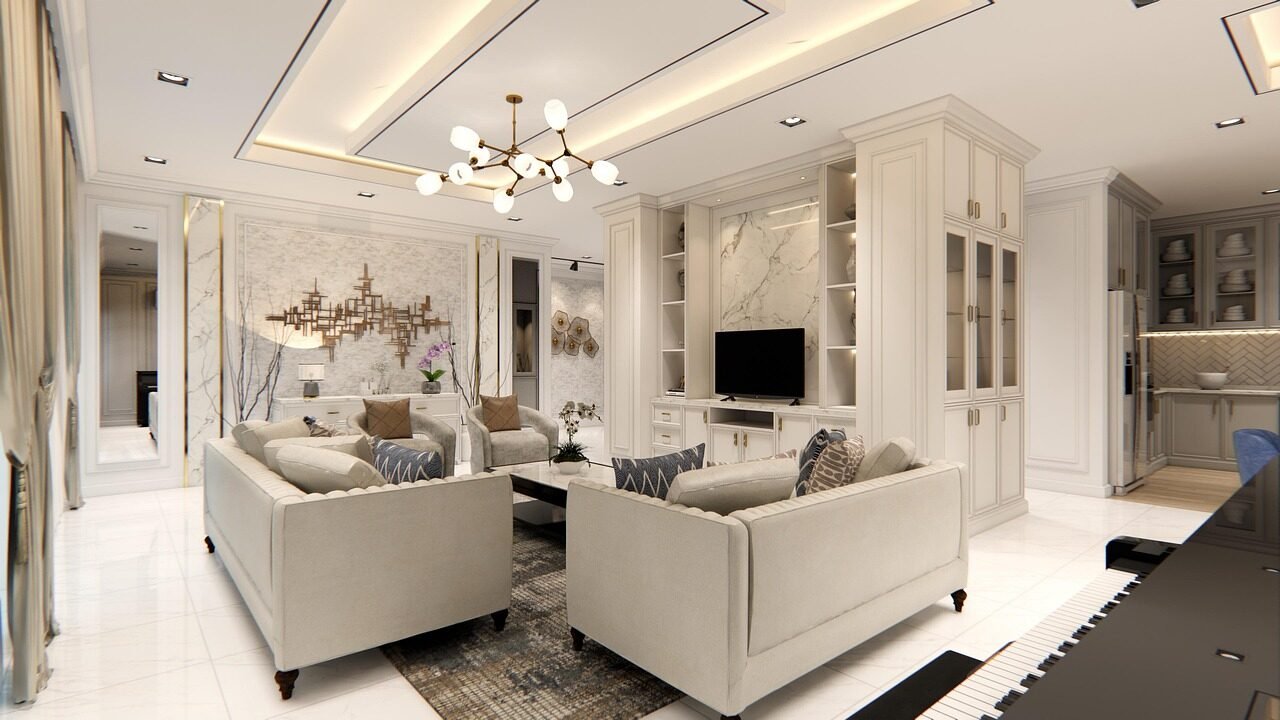
The biggest mistake people make in living rooms is pushing all the furniture against the walls. Although it appears to increase “space,” it actually causes a room to feel cold and disconnected. Pull your sofa and chairs inward, facing each other, with a coffee table between. Float the furniture. It creates a defined conversation zone and makes the room feel intentionally designed, not just filled up.
Add a large area rug that extends under at least the front legs of every major piece — this visually ties the seating area together and grounds the whole arrangement.
Bedroom: Put relaxation ahead of appearances.
A bedroom should be a sanctuary. That means blackout curtains or lined drapes, soft lighting only (no overhead white LEDs at night), and a neutral, calm color palette — think muted sage, warm greige, dusty blue.
Layering your bedding is a quick and easy way to make any bedroom look better. A fitted sheet, a flat sheet, a duvet, and a folded throw blanket at the foot of the bed — it looks like a hotel but feels like home. Add two or three differently-sized throw pillows for texture.
Keep surfaces minimal. A lamp, a book, or possibly a small plant on each nightstand are the only items there. That’s it. Even if the rest of the room is fine, a bedroom that has too many items on its nightstands feels cluttered.
Kitchen: Function First, Style Second
Kitchens are functional spaces, and the best-looking kitchens lean into that rather than fighting it. Open shelving is a popular trend, but be honest with yourself — if your dishes aren’t uniform or you don’t maintain them obsessively, closed cabinets will serve you better.
Where you can add personality without adding chaos:
A striking tile for the backsplash that is even peel-and-stick for renters Matching canisters or apothecary jars for pantry staples on the counter
A piece of art or a framed print on the one wall that isn’t covered by cabinets
A simple herb garden on the windowsill — functional and beautiful
Home Office: Don’t Neglect This One
Since remote and hybrid work became the norm, the home office went from a nice-to-have to an essential. Despite this, it is still the most neglected room in many homes, with a folding table in the corner, poor lighting, and a jumble of cords. To be honest, this room matters for your productivity and your mood more than any other. Invest in a good chair before you invest in a nice lamp. Good posture is not optional if you’re sitting for eight hours a day.
Beyond ergonomics: cable management (cord clips or cable boxes make a huge difference), a gallery wall above the desk, and at least one plant at desk height. The visual stimulation of a well-thought-out workspace genuinely reduces fatigue during long work sessions.
For more ideas on creating a productive yet beautiful workspace, check out our guide on [Home Office Design Ideas] that blend function with great style.
Decorating on a tight budget: How to get the most for the least amount of money
One thing I genuinely appreciate about the home decor ideas TheHomeTrotters community is the emphasis on decorating well without going broke. Here’s what actually moves the needle on a limited budget:
Furniture from estate sales and thrift stores often has excellent bones that can only be reupholstered or painted. Rearranging the things you already have is free and frequently surprising effective. Swapping out hardware — cabinet knobs and drawer pulls on kitchen or bathroom cabinets are cheap, easy to replace, and make an outsized visual impact
Large-format art prints — sites like Unsplash offer free high-res images you can print at a local print shop for a fraction of gallery prices
Mirrors — they bounce light, create the illusion of space, and come in every price range. A well-placed large mirror is one of the highest-ROI decorating moves you can make
Common Home Decor Mistakes (And How to Avoid Them)
Let me be straight with you — I’ve made most of these mistakes myself at some point.
Choosing a rug that’s too small: If your rug doesn’t extend at least under the front legs of your main furniture pieces, it’ll make the room feel mismatched and smaller
Hanging art too high: Eye level is the guide — 57 to 60 inches from the floor to the center of the artwork is the standard. The majority hang it too high.
Ignoring scale: Small accessories on large pieces of furniture or large pieces of furniture in a small space make the space feel unfinished.
Trendy over timeless: Trends are fun, but building a room entirely around what’s “in right now” means you’ll be redecorating again in two years. Use trends as accents, not foundations
No cohesion between rooms: Rooms don’t have to match, but they should feel like they belong to the same home. Repeating one color, material, or style element across rooms creates visual flow
A Quick Step-by-Step Home Decor Refresh
If you are unsure where to begin, the following straightforward procedure applies to any room:
Edit first — remove everything that you wouldn’t choose again if you were starting from scratch
Define the goal—what does this space serve? What mood should it have? Write it down: “calm and restful” or “energizing and creative”
Fix the lighting — add or swap bulbs for warm-toned LEDs (2700K–3000K), add a lamp if there’s only overhead lighting
Address the largest surface first — the walls, floor, or largest piece of furniture; get that right before touching accessories
Layer texture — throw blanket, cushions, a rug, a plant; different textures make a room feel rich even in neutral color palettes
Edit again: take a step back, live in it for a week, and then take out anything that still doesn’t feel right.
Most Commonly Asked Questions
Q: What’s the most impactful single change I can make to improve my home decor?
Without a doubt, lighting. A room’s mood can be dramatically altered by switching from harsh overhead lighting to warm, layered light sources without changing the furniture. Swap standard cool-white bulbs for warm white (2700K–3000K) and add at least one secondary light source per room.
How can I increase the size of a small room without tearing down walls? Use a large mirror on one wall, select furniture that is raised on legs to show floor space, stick to a light and consistent color scheme, and opt for sheer or linen panels that let in natural light rather than heavy drapes. Vertical lines (tall bookshelves, floor-length curtains hung close to the ceiling) also draw the eye upward and make ceilings feel higher.
Q: Can I mix different interior design styles, or does everything need to match?
Mixing styles is not only acceptable — it’s what makes a home feel personal rather than showroom-staged. The key is finding a common thread: a shared color tone, a material (like warm wood or matte black metal), or a level of visual complexity. Even if the items themselves are made in very different styles, eclectic rooms that appear to be cohesive typically share a common feature.
Decorating a home is one of those things that sounds simple — until you’re standing in the middle of a room that just feels wrong and you can’t quite name why. The truth is, good design is less about expensive taste and more about understanding a handful of principles and applying them with intention.
Whether you’re working with a rented apartment, a first house, or a room you’ve lived in for years and just grown tired of — there is always something you can do. Move a piece of furniture. Swap a light bulb. Add one plant. Start somewhere small and see what happens. The best-decorated homes I’ve ever been in didn’t get that way all at once. They evolved, slowly, as the people in them learned what they actually loved.
That’s what home decor ideas TheHomeTrotters gets right — it’s about the journey of making a space your own, not the destination of achieving some impossible perfection.